
Search "resume templates" and most of what comes back is decoration: two columns, a sidebar, a photo, a row of little bars rating your skills out of five. That's a design decision someone made for you, and it's usually the wrong one. The three templates below go the other way. They're plain on purpose, and instead of leaving you a blank line under each heading, every slot tells you what belongs in it.
Why most resume templates work against you
Two reasons, and both are about being read at all.
The first is the software. At large employers your resume goes through an applicant tracking system before a person opens anything — roughly 97% of Fortune 500 companies run one [1] — and that software reads top to bottom, left to right. Tables, columns, text boxes and graphics confuse it. In one Jobscan test, a design-heavy two-column resume came out the other side with only the work-experience section: no skills, no contact details, no links [2].
The second is the person. In a widely cited eye-tracking study by the job-search platform Ladders, recruiters spent an average of about 7.4 seconds on their first pass over a resume, and multi-column layouts made that pass worse [3]. A template that fights the software and the seven-second skim isn't a head start. It's a handicap you paid for.
So these templates are boring by design. What they add instead is the part nearly every template skips: a prompt in each slot telling you what to write there. A blank line under "Experience" is not help.
Three templates you can download
Three situations, three structures. Tap or click any template to open the PDF, then fill in the brackets and delete them as you go.
1. The standard template
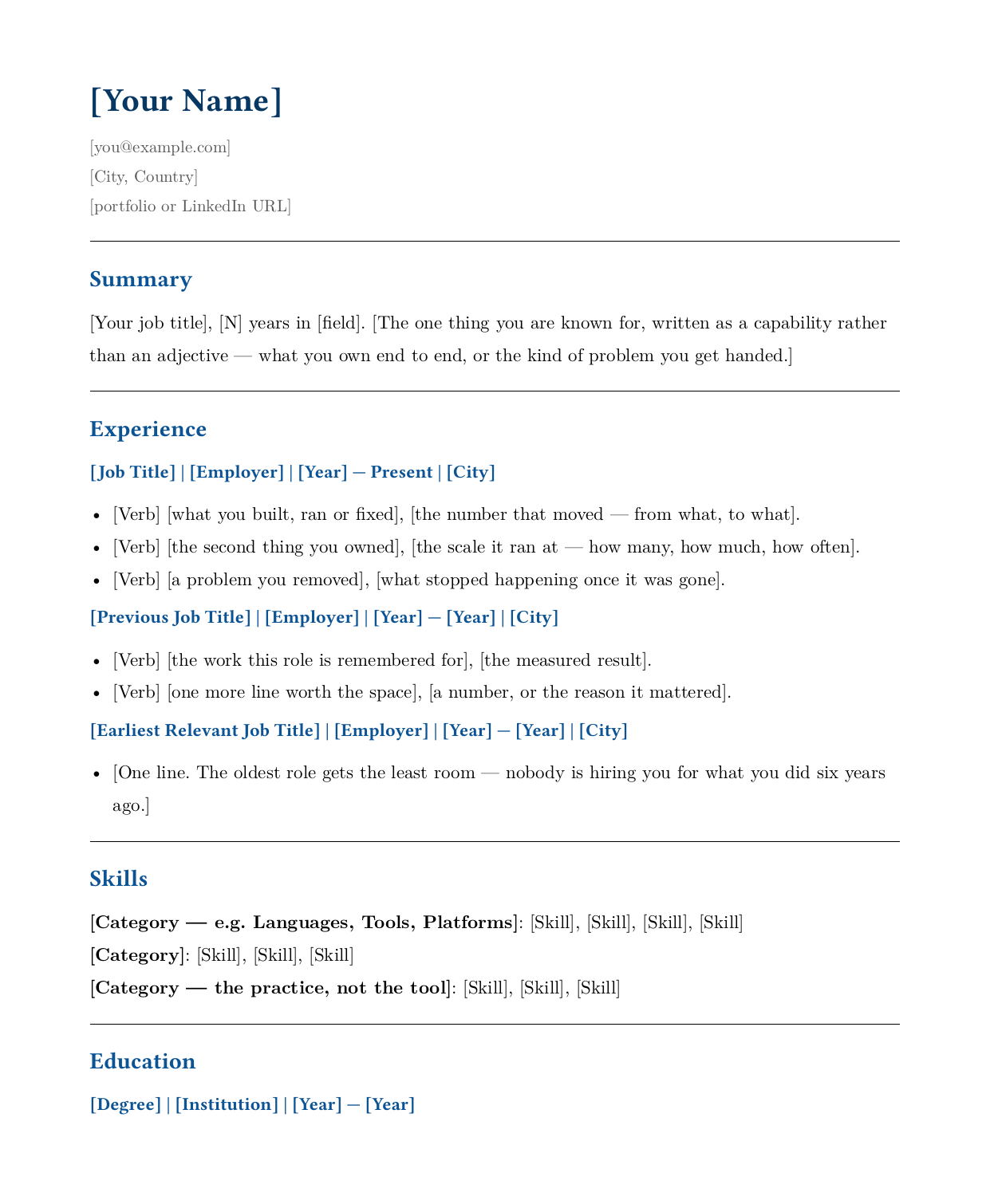
Reverse-chronological — summary, experience newest first, skills, education. This is the right structure for most people, and it's the one both the software and the recruiter expect. Note the shape of the experience section: three bullets on the current role, two on the previous, one on the oldest. Space follows relevance, not chronology. Open the PDF.
2. The career-changer template
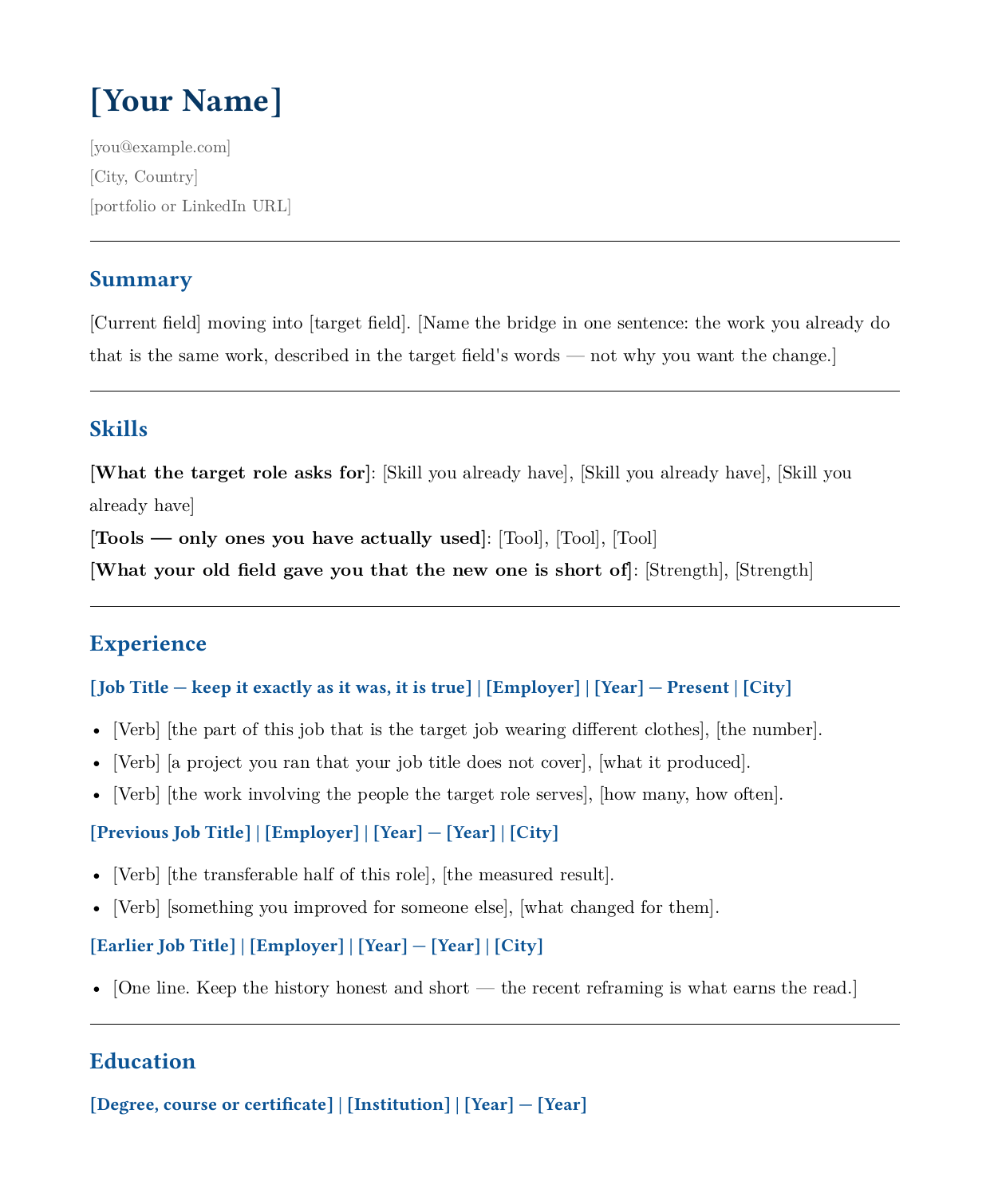
Same bones, resequenced. The summary names the move in its first line instead of hoping the reader works it out, and skills sit above experience so the reader sees what you can do before they see where you did it. The job titles stay exactly as they were — reframing a bullet is honest, rewriting a title isn't. Open the PDF.
3. The first-job template
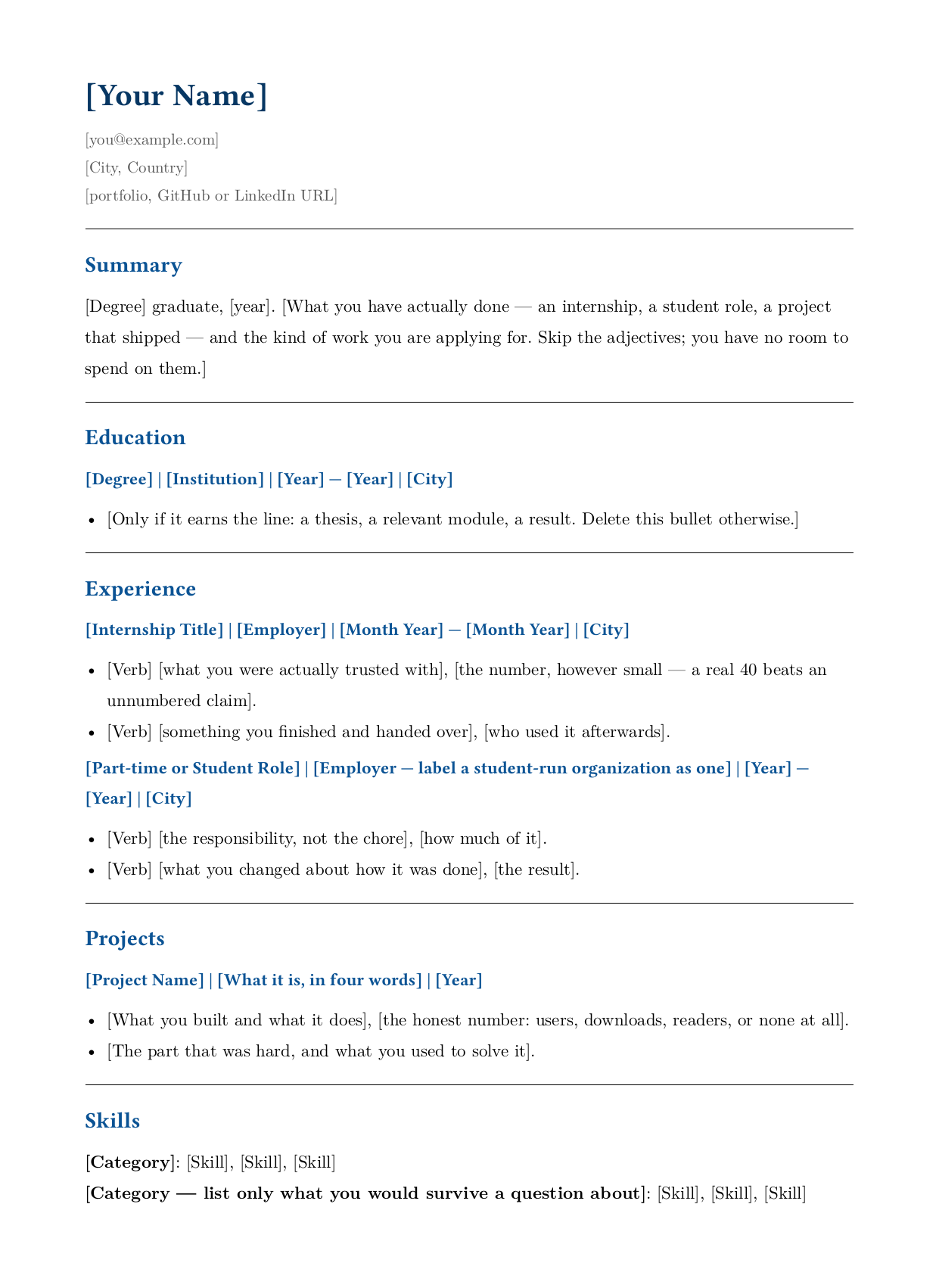
Education moves up, because with a year or two of work it's genuinely your strongest section, and a Projects block gives a real thing you built somewhere to live. The prompts push for numbers even when they're small — a real 40 beats "passionate about marketing." Open the PDF.
What goes in each slot
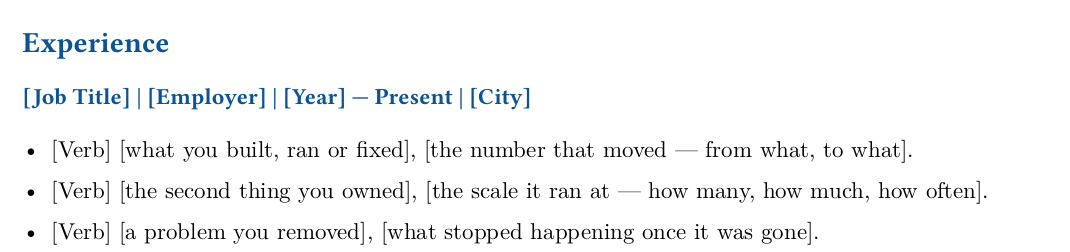
The first experience entry of the standard template. Every bracket is an instruction, not a blank.
- The header — name, email, city, and one link worth clicking. No section heading, no photo, no job title under your name; the reader wants to know who you are and how to reach you, in four lines.
- The entry line — job title, employer, dates, city, in that order, on one line. Keep the order identical in every entry: the screening software and the seven-second skim are both pattern-matching, and a consistent line is the pattern.
- The bullets — verb, what you did, what changed. The prompt asks for the number on purpose. A third of hiring managers treat a resume with no quantifiable results as an instant deal-breaker [4], so give the skim something to land on.
- The summary — your role, your years, and the one thing you're known for, written as a capability rather than an adjective. "Owns services end to end" tells a reader something; "results-driven professional" doesn't.
- The skills — grouped and comma-separated, one line per group. Group by what the reader is looking for, and list only what you'd survive a question about.
- The education — one line, unless it's your strongest section, in which case it moves up and earns a bullet.
Which one to use
- Standard, if your recent roles are in the field you're applying to. That covers most people, most of the time.
- Career changer, if the field is different. It's a hybrid — skills forward, but the dated history is still there — which matters, because the fully functional format that hides the timeline reads as evasive to recruiters and gives the screening software less structured history to work with [5].
- First job, if you have less than about two years of work. Not because you should hide that, but because education and projects are the sections with something in them.
The rules these templates already follow
- One column, standard headings, no graphics. The layout is doing nothing clever, and that's the feature [2].
- One page here, two at most. Recruiters preferred two-page resumes over one-page ones for experienced roles by more than two to one in a ResumeGo hiring simulation [6] — but 17% of hiring managers treat anything over two pages as a deal-breaker [4]. Two pages is the ceiling, not the target.
- Bullets, not paragraphs. A quarter of hiring managers are put off by long blocks of text [4], and a seven-second scan can't read them anyway.
- Proofread twice. Typos and bad grammar are the single most common instant deal-breaker, at 77% [4] — and the easiest one to avoid.
If you're still deciding which structure fits you, the best resume format covers the choice itself. If you'd rather see these slots filled in with real content, the resume examples are three complete resumes with the edits behind their bullets. And the letter that goes with the resume has its own set: the cover letter examples. The blank set for the letter is here too: the cover letter templates.
What a template can't do for you
A template gets you a structure and a set of prompts. It cannot point that structure at a specific company — and that's the part the reader is actually judging. Nearly one in five hiring managers rejects a resume for being generic, not customized to the company [4]. Clearing that bar means re-pointing your resume for every application: leading with different experience, mirroring different language, matching the specific posting, then doing it again for the next company, and the next. A real search is dozens of applications. Done properly that's hours of rewriting a week, which is exactly why most people fill a template in once and send the same file everywhere.
…and this is exactly what Hiresling.ai does for you
Hiresling.ai takes your real experience and re-expresses your resume for each role — leading with what matters to that company, in language that matches that posting — in a clean, single-column layout the screening software reads without complaint. It then writes the outreach that carries it, sends it from your own inbox, and follows up. Nothing goes out until you approve it: you accept it, reject it, or ask for changes. The template is the ten-minute part. Hitting that bar on every single application is the part you don't do by hand.
One honest note: no template, and no tool, guarantees an interview. A clean, quantified, well-pointed resume improves your odds of being read by the right person. That's the real promise. What's in it still has to be true, and worth reading.
References
- Jobscan, Applicant Tracking System (ATS) Usage Report, 6th ed. (2026) — vendor (makes tools that help resumes pass automated screening); manual review of all 500 Fortune 500 career pages. jobscan.co
- Jobscan, Resume Tables and Columns vs. Automated Screening — vendor; single illustrative test. jobscan.co
- Ladders, Eye-Tracking Study (2018) — vendor (job-search platform); eye-tracking of 30 professional recruiters over 10 weeks; average initial scan ~7.4 seconds. Independent coverage: HR Dive
- CareerBuilder, Employers Share Their Most Outrageous Resume Mistakes and Instant Deal-Breakers (2018) — national survey of 1,138 hiring and HR managers, conducted by The Harris Poll. prnewswire.com
- Jobscan, What Recruiters Think of the Functional Resume Format — vendor; qualitative recruiter opinion, not a survey. jobscan.co
- ResumeGo, One or Two Page Resumes: Which Is Better? (2018) — vendor (resume-writing service) hiring simulation; 482 reviewers, 7,712 resumes. resumego.net