Search "cover letter examples" and you'll get fill-in-the-blank templates: the same four paragraphs with your name dropped into the gaps. They'll pass for a cover letter. They won't do the one thing a cover letter exists to do, which is give a busy person a reason to keep reading. Below are three complete letters you can read end to end, the specific edits that move an opening line from skipped to read, and the research on what a hiring manager actually does with the thing. And the honest part: doing this for every company you apply to.
What a hiring manager actually does with it
They read it more often than the internet suggests. In a survey of 625 hiring managers by Resume Genius, 73% said they frequently or always read cover letters even when one isn't required [1], and in a separate national survey, 10% called a missing one an instant deal-breaker [2].
But reading it and being moved by it are different. In a field experiment of more than 7,000 applications by the resume-writing firm ResumeGo, applications with a letter written specifically for that job drew a 53% higher callback rate than applications with no letter at all — while a generic, one-size-fits-all letter drew 12.5% against 10.7% for no letter at all [3]. That's the whole game in one number. The letter isn't the differentiator. The tailoring is.
So the examples below aren't here to be copied. They're here to show what "tailored" looks like when someone actually does it.
Three complete cover letters
Each is one page, addressed to a named person, and built on the standard structure covered in Best Cover Letter Format. Click any letter to open the PDF. The people and companies are invented; the writing is the point.
1. Mid-career specialist
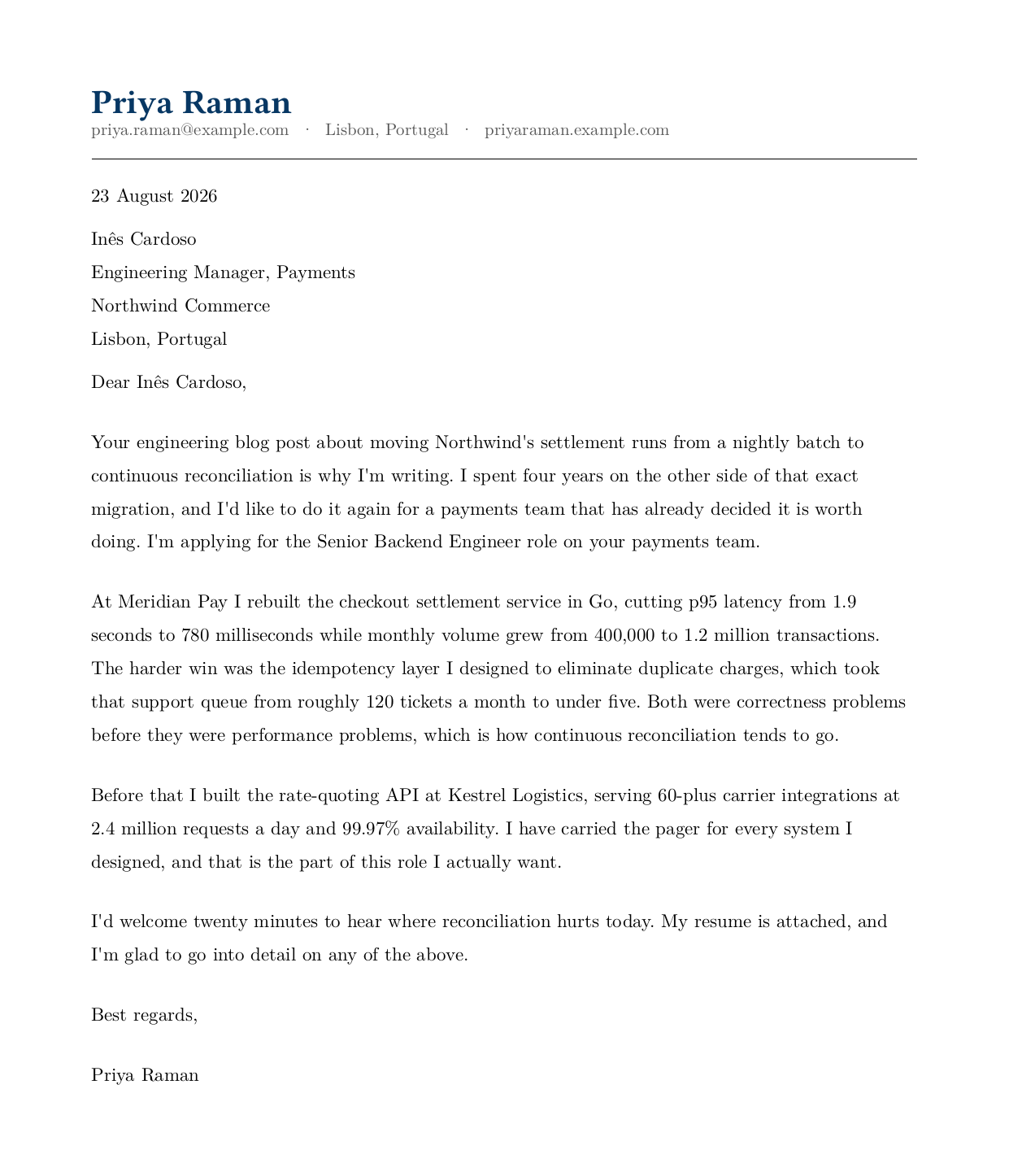
Eight years of experience is enough to make a letter boring — it becomes a list. This one doesn't list. It picks the one migration this company has publicly said it's doing, and shows up as somebody who has already been through it.
2. Career changer
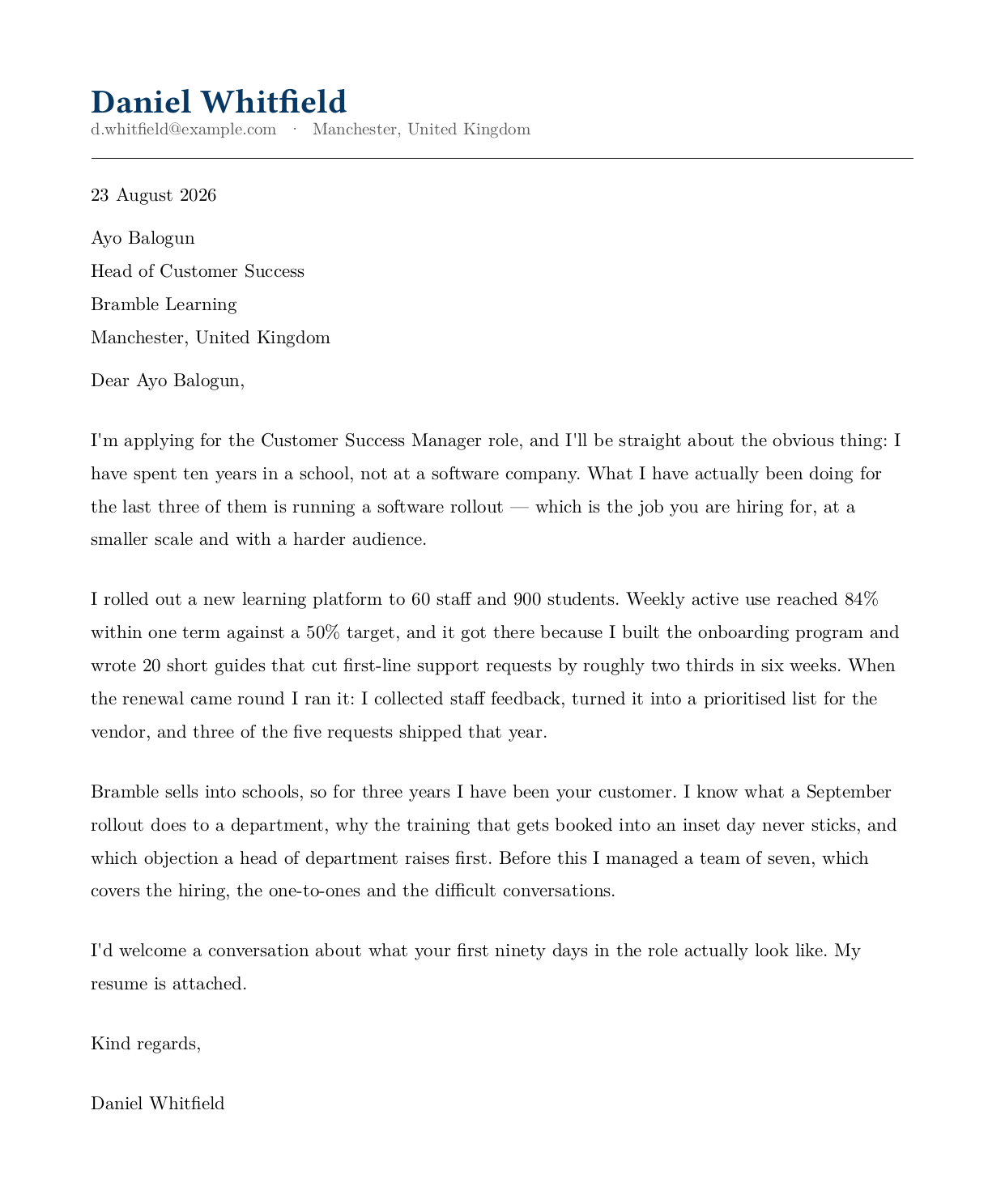
The career-change letter has one job the others don't: answer the objection before it's raised. Naming the gap in the first sentence costs nothing and buys the rest of the page.
3. First job out of university
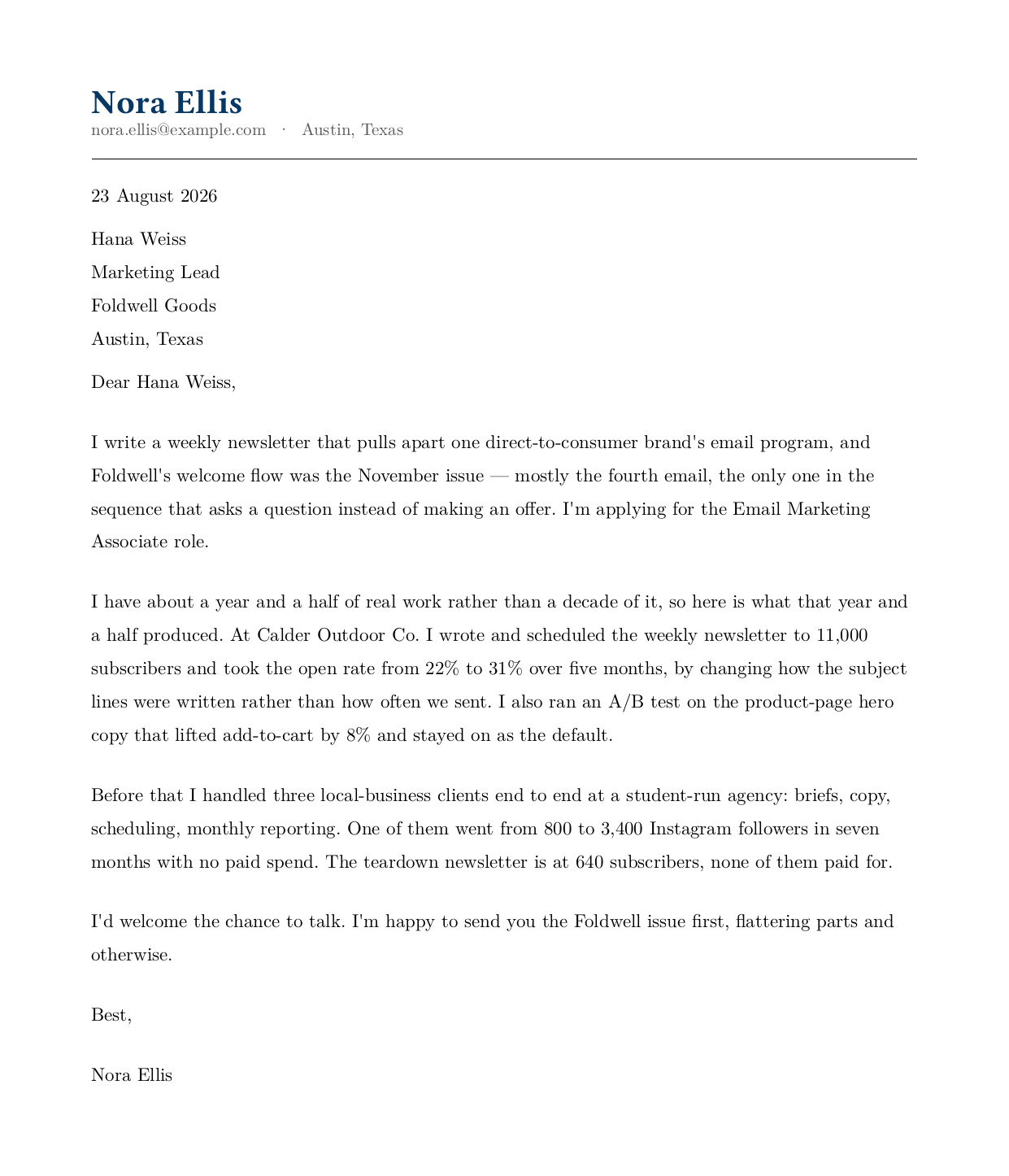
With a year and a half of experience you can't win on depth, so this one wins on attention: it opens with something about the company that you could only know by looking closely.
The resume side of the same set is Resume Examples: What Makes a Bullet Get Read, and if what you're sending is a cold email rather than a letter, How to Write a Cold Email That Doesn't Read Like a Template is the same exercise in a shorter form. Blank versions of the resumes, with a prompt in every slot, are in the resume templates. Blank versions of these three letters, with a prompt in every slot, are in the cover letter templates.
The edits behind those opening lines
The opening line decides whether the rest gets read. Here's the same first sentence, written the way most letters do it and the way these three do.
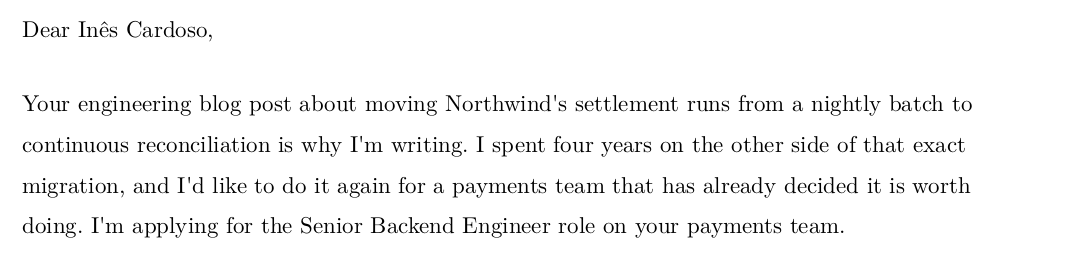
Before: I am writing to express my interest in the Senior Backend Engineer position at Northwind Commerce.
After: Your engineering blog post about moving Northwind's settlement runs from a nightly batch to continuous reconciliation is why I'm writing.
The first sentence is true of every applicant. The second could only have been written by someone who read something the company published. Purdue's writing lab makes the same point about the greeting one line above it: addressing a specific person gives your letter "a greater chance of having your application packet read and not filed away" [4].
Before: I believe my transferable skills make me an excellent candidate for this role.
After: I'm applying for the Customer Success Manager role, and I'll be straight about the obvious thing: I have spent ten years in a school, not at a software company.
"Transferable skills" is what people write when they don't want to say the thing. Saying it costs one clause and makes everything after it credible.
Before: Although I am a recent graduate, I am a highly motivated self-starter with a passion for marketing.
After: I write a weekly newsletter that pulls apart one direct-to-consumer brand's email program, and Foldwell's welcome flow was the November issue — mostly the fourth email, the only one in the sequence that asks a question instead of making an offer.
Nobody can check "highly motivated." Everybody can check the fourth email in their own welcome sequence.
The same letter, pointed at a different job
This is the part templates can't do for you. Below is one candidate, one career, two openings — written for a payments role and for a data-infrastructure role. Nothing was invented for either. The same eight years of work gets introduced by whichever piece of it the reader is hiring for.
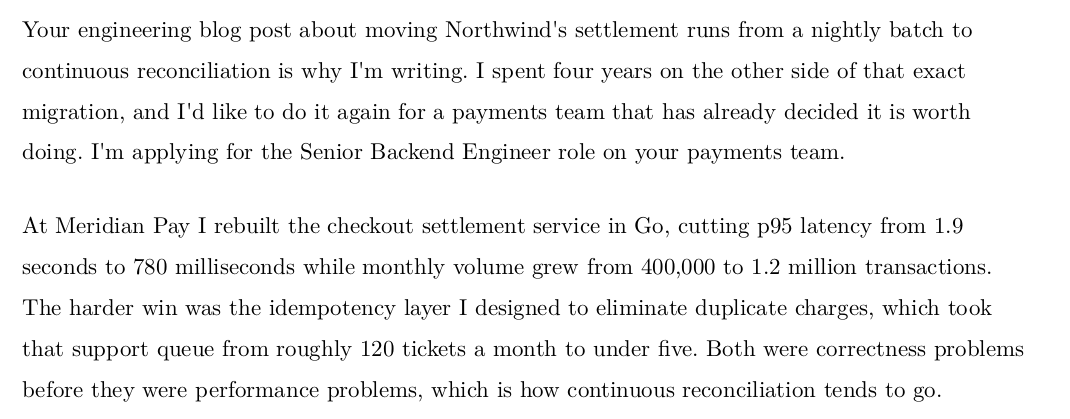
The payments version leads with settlement and reconciliation, and the numbers it reaches for are latency and duplicate charges.
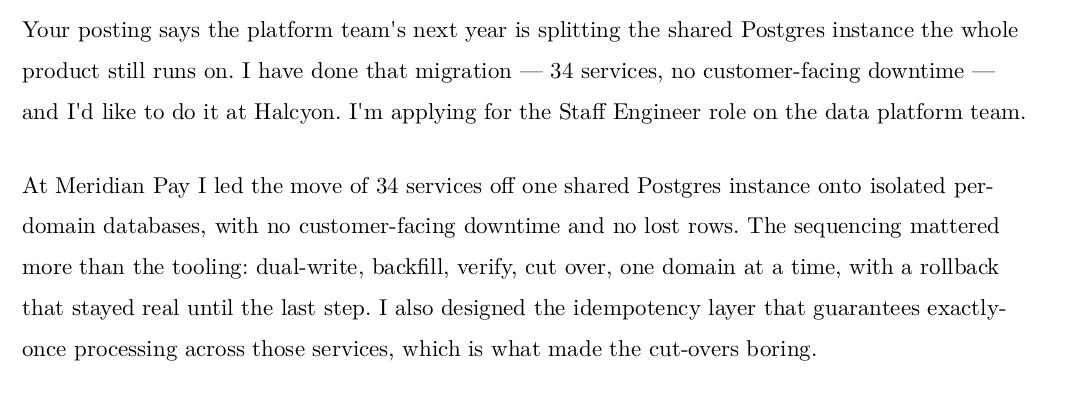
The data-platform version leads with the database split, and the detail it spends its second paragraph on is the sequencing — dual-write, backfill, verify, cut over — because that's what the reader will be nervous about.
Same person. Same eight years. Two letters, because two different people are reading.
The rules these letters follow
- One page, three or four short paragraphs [5][6]. None of the letters above reaches 250 words, and none of them needs to. If yours runs past a page, cut — the overflow doesn't get read.
- A named person, not a department. "Dear Ayo Balogun," not "To Whom It May Concern" [4].
- The opening earns the second paragraph. Something specific about this company, framed as the reason you're writing — not a compliment, a bridge [7].
- Two or three claims, each with a number or an outcome. Not a re-reading of your resume; the two or three things that make you a fit for this job [5].
- One low-friction ask. "I'd welcome twenty minutes," not "please review my attached credentials at your convenience."
- Say the awkward thing first. A career change, a gap, a missing credential — name it in a clause and move on. It never gets less awkward further down the page.
What the examples don't show
They don't show the hours. Each of these letters took a real look at one company: reading what they publish, working out who the letter should go to, and choosing which two of your last eight years matter to them. That's twenty to forty minutes per company, done well.
Which is why almost nobody sustains it. Across a search of thirty or forty companies, the tailoring quietly becomes one generic letter sent everywhere — and the research puts a generic letter at 12.5% callbacks against 16.4% for a tailored one [3].
…and this is exactly what Hiresling.ai does for you
The format is a template you learn once. The tailoring is the work — and it's the work Hiresling.ai does for you. Hiresling.ai takes your real experience and writes a specific, per-company message that maps to what that team needs, then sends it from your own inbox, reaching the hiring manager directly. It applies to open roles too. Nothing goes out until you approve it. You keep the judgment. Hiresling.ai does the per-company writing that makes a letter worth reading.
One honest note: no letter, and no tool, guarantees an interview. A specific, genuinely tailored letter improves the odds that someone reads you properly and takes you seriously. What's in it still has to be true, and worth their time.
References
- Resume Genius, Cover Letter Statistics — vendor; survey of 625 U.S. hiring managers via Pollfish. resumegenius.com
- CareerBuilder, Employers Share Their Most Outrageous Resume Mistakes and Instant Deal-Breakers (2018) — survey of 1,138 hiring and HR managers, conducted by The Harris Poll. prnewswire.com
- ResumeGo, Does a Cover Letter Matter? A Field Experiment (2020) — vendor (resume-writing service); 7,287 applications, three arms (none / generic / tailored). resumego.net
- Purdue OWL, Addressing Cover Letters — Purdue University Writing Lab. owl.purdue.edu
- Purdue OWL, Cover Letters: Quick Formatting Tips — Purdue University Writing Lab. owl.purdue.edu
- Indeed Career Guide, What's the Ideal Cover Letter Length? — editorial guidance. indeed.com
- Amy Gallo, How to Write a Cover Letter, Harvard Business Review (2014, updated 2020). hbr.org