Search "resume examples" and you'll drown in templates: tidy layouts, filler bullets, nothing that tells you why one version gets read and another gets skipped. The useful question isn't what a resume looks like. It's what a hiring manager does with it in the few seconds before they decide whether to keep reading. Below are three complete resumes you can read end to end, the specific edits that move a bullet from ignored to read, and the research on what changes a hiring manager's mind. And the honest part: doing this for every company you apply to.
Every resume on this page was produced by Hiresling.ai, in the format it generates. The people, their employers, and their schools are invented, and the addresses are all @example.com. The structure, spacing, and wording are exactly what comes out of the product.
What happens in the first few seconds
Before anyone reads your resume closely, two things happen fast. At the largest employers it passes through an applicant tracking system first: the software recruiters use to search and rank the pile, which means a resume that doesn't match the search never surfaces to a human at all. Roughly 97% of Fortune 500 companies run one [4]. Then a person gives it a quick scan. In a widely cited eye-tracking study by the job-search platform Ladders, recruiters spent an average of about 7.4 seconds on that first pass [2]. Seconds, not minutes. So the examples below aren't about elegance. They're about surviving a fast, skeptical skim.
The deal-breakers, from the people doing the deciding
In a 2018 survey of more than 1,100 hiring and HR managers, the instant deal-breakers were specific and consistent [1]. Typos or bad grammar sank a resume for 77% of them, the single most common one. A third (34%) said a resume with no quantifiable results was an instant no. A quarter (25%) were put off by long paragraphs of text. Nearly one in five (18%) rejected resumes that were generic, not customized to the company. The good news: every one of those is fixable, and you can see the fix in a single bullet.
Three complete resumes
Three different situations: mid-career specialist, career changer, first job out of university. Tap or click any resume to open the PDF.
1. Mid-career specialist
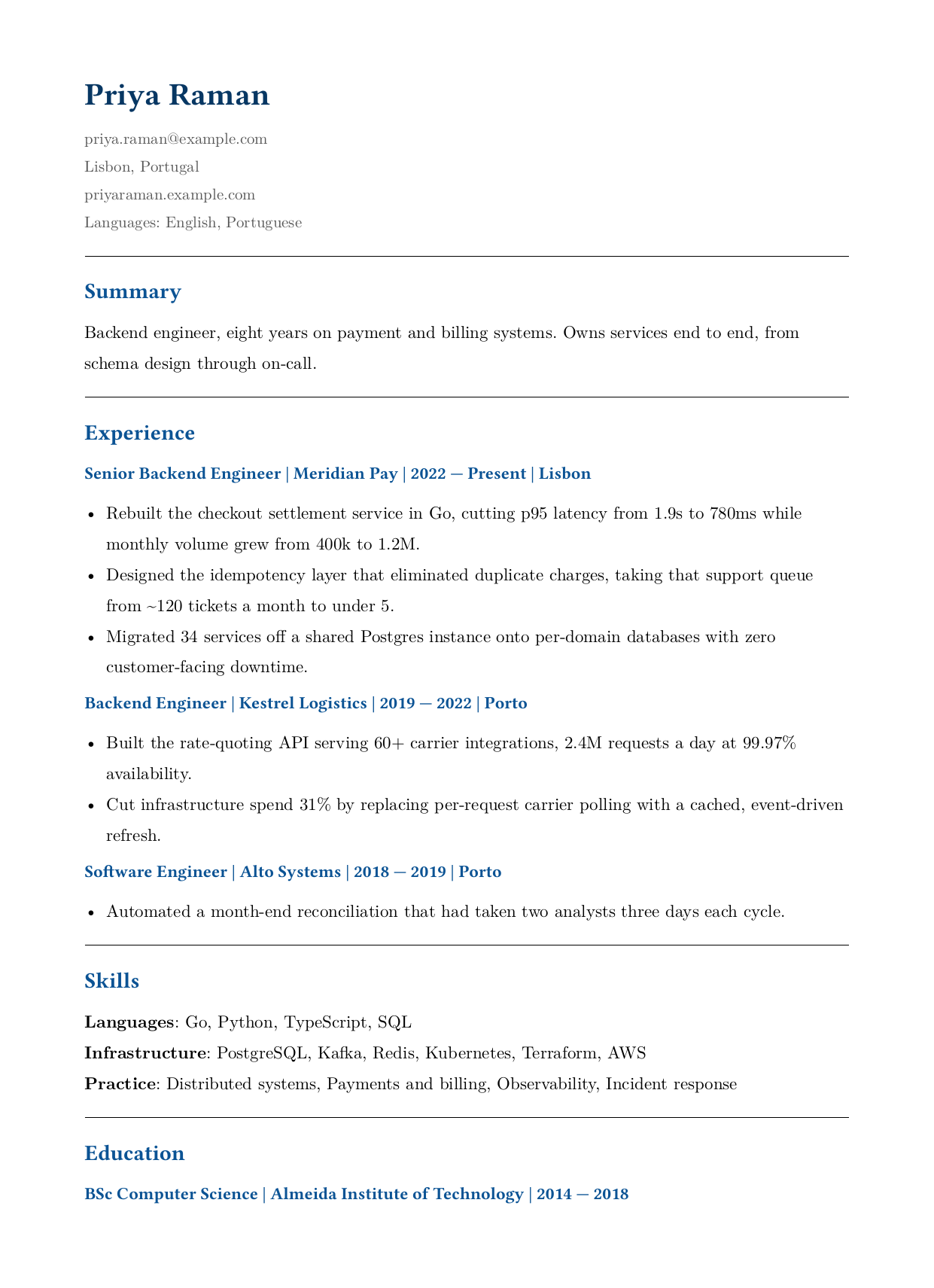
Eight years of experience, one page. Every bullet leads with a verb and carries a measured result: latency cut from 1.9s to 780ms, a support queue reduced from ~120 tickets a month to under 5. The oldest role gets one line, because nobody is hiring you for 2018. Open the PDF.
2. Career changer
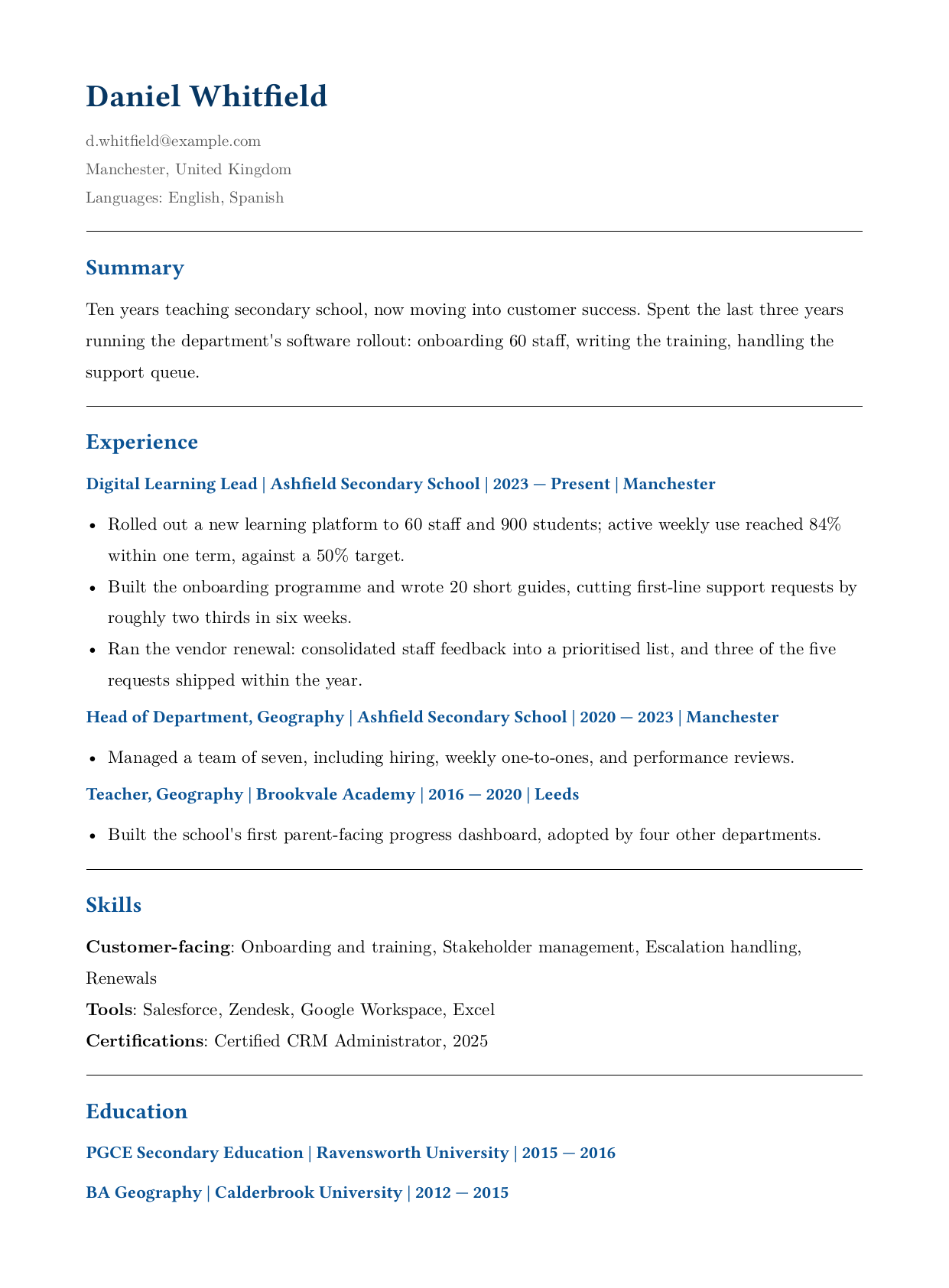
Ten years in teaching, applying for customer success. The summary names the move in the first line instead of hoping the reader works it out, and the bullets pull out the transferable work (a rollout to 60 staff, an onboarding program, a vendor renewal) instead of the lesson plans. The job titles are unchanged, because they're true. Open the PDF.
3. First job out of university
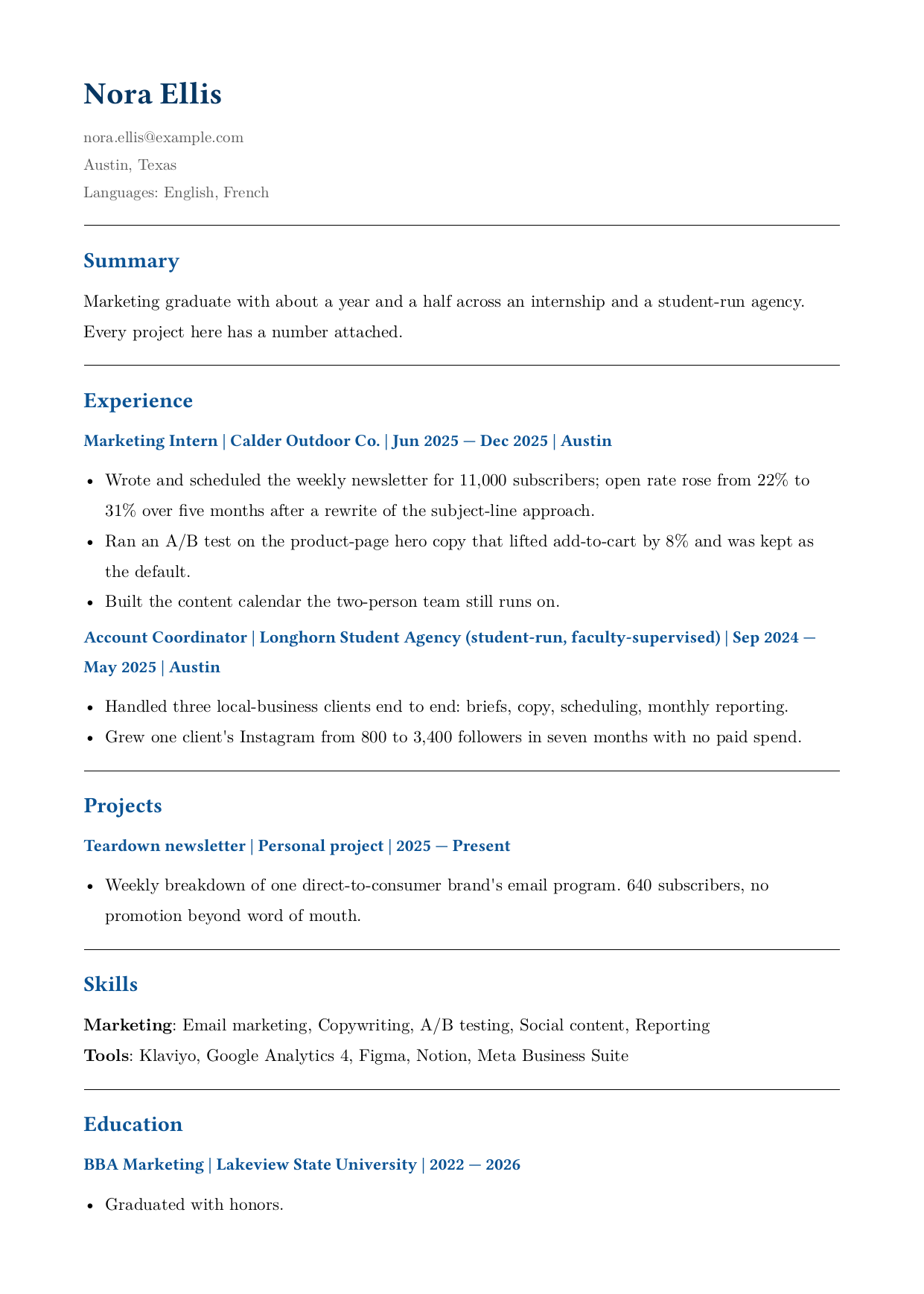
About a year and a half of real work, and the resume doesn't pretend otherwise. A student-run agency is labeled as one. The numbers are honest rather than impressive, a newsletter of 11,000 and a side project with 640 subscribers, and they're there anyway, because a small real number beats "passionate about marketing". Open the PDF.
The edits behind three of those bullets
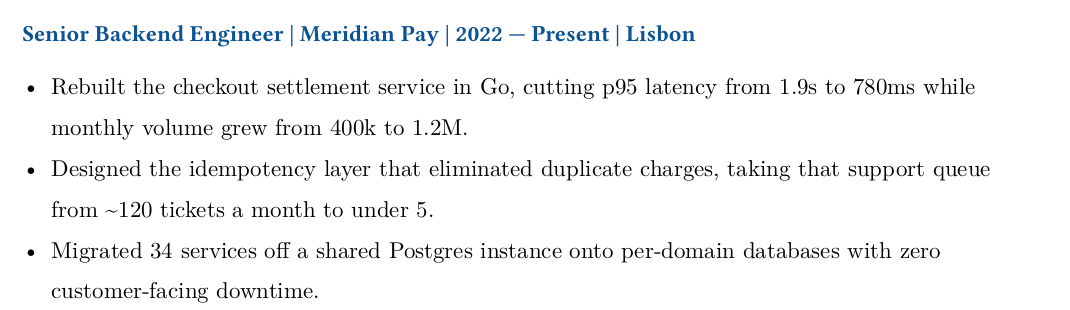
Three bullets from the first example. Verb, what you did, what changed.
Most resume advice stops at "use numbers". The more useful version is the edit itself. Each "after" below is a line you can find in the resumes above.
Vague duty into measurable result. A third of hiring managers treat missing numbers as a deal-breaker [1], so give the skim something to land on.
Before: Responsible for the checkout settlement service.
After: Rebuilt the checkout settlement service in Go, cutting p95 latency from 1.9s to 780ms while monthly volume grew from 400k to 1.2M.
The work is identical. The second version proves it.
Adjectives into evidence. "Results-driven team player with a proven track record" tells a hiring manager nothing they'll believe. Delete the claim and show the thing:
Before: Results-driven educator with a proven track record of stakeholder engagement.
After: Rolled out a new learning platform to 60 staff and 900 students; active weekly use reached 84% within one term, against a 50% target.
A number a skeptic can picture beats an adjective they'll skip.
Wall of text into scannable. A quarter of hiring managers are put off by dense paragraphs [1], because a seven-second scan can't read them.
Before: a five-line paragraph about running social media for three local clients.
After: Handled three local-business clients end to end: briefs, copy, scheduling, monthly reporting. and Grew one client's Instagram from 800 to 3,400 followers in seven months with no paid spend.
Same content, now it survives the skim.
The same resume, pointed at a different job
Nearly one in five hiring managers rejects a resume that reads like it was sent to everyone [1]. Below is the same person and the same facts, applying to two different companies. Nothing was invented. The order and the framing changed.
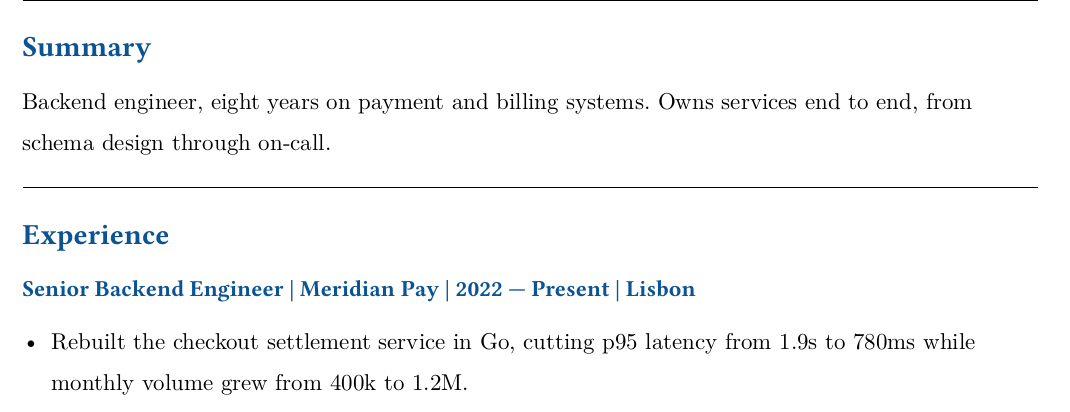
Applying to a payments company. The summary leads with payments, and the top bullet is the checkout rebuild.
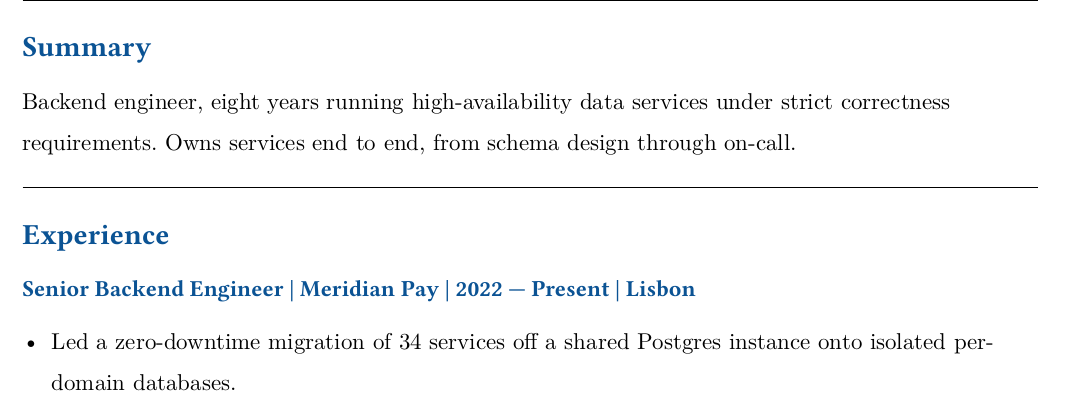
Applying to a data-infrastructure company. Same person, same roles, same dates. Now the zero-downtime migration is the first thing you read.
Every figure is identical on both versions, down to the ticket counts and the latency. Only one of them is written for the job in front of you, and which one that is depends on the job. That's what tailoring actually means.
The structural rules these examples follow
- One page here, two at most. In a hiring-simulation study by the resume service ResumeGo, reviewers preferred two-page resumes over one-page ones by more than two to one for experienced roles [3], but the same hiring-manager survey found 17% treat anything over two pages as a deal-breaker [1]. Two pages is the ceiling, not the target. All three examples fit on one because the content fit on one.
- Plain formatting, on purpose. Because a recruiter finds you by searching that system [4], the examples stay simple: one text column, conventional section headings, no boxes or graphics. The eye-tracking study found multi-column layouts hurt human readers too [2]. More on that in the best resume format.
- Proofread twice. It's the number-one deal-breaker [1] and the easiest one to avoid.
The cover-letter side of the same set is Cover Letter Examples That Don't Read Like a Template — three complete letters, and the edits behind their opening lines. If you'd rather start from a blank one, the resume templates are those same structures empty, with a prompt written into every slot.
What the examples don't show
Every rewrite above is easy to admire and easy to do once. The catch is the tailoring. To clear the "generic" bar you can't write one great resume and send it everywhere. You have to re-point it at every company: lead with different experience, mirror different language, match the specific role, then do it again for the next company, and the next. A real search is dozens of applications. Done properly that's hours of rewriting a week, which is exactly why most people send the same generic version everywhere and land in the 18% pile.
…and this is exactly what Hiresling.ai does for you
Hiresling.ai takes your real experience and re-expresses your resume for each role, leading with what matters to that company, in language that matches that posting, so every application clears the "generic" bar without you rewriting it by hand. That's what the two versions above are: one resume, pointed at two different companies. Hiresling.ai does the same for the outreach that goes with each one, and nothing is sent without your approval. You accept it, reject it, or ask for changes. This isn't a faster version of what you were doing. It's a volume of genuinely tailored applications you could not hand-write at all.
One honest note: no resume, and no tool, guarantees an interview. A well-tailored, quantified, cleanly formatted resume improves your odds of being read by the right person. That's the real promise. What's on it still has to be true, and worth reading.
References
- CareerBuilder, Employers Share Their Most Outrageous Resume Mistakes and Instant Deal-Breakers (2018) — national survey of 1,138 hiring and HR managers, conducted by The Harris Poll. prnewswire.com
- Ladders, Eye-Tracking Study (2018) — vendor (job-search platform); eye-tracking of 30 professional recruiters over 10 weeks; average initial scan ~7.4 seconds. Independent coverage: HR Dive
- ResumeGo, One or Two Page Resumes: Which Is Better? (2018) — vendor (resume-writing service) hiring simulation; 482 reviewers, 7,712 resumes. resumego.net
- Jobscan, Applicant Tracking System (ATS) Usage Report, 6th ed. (2026) — vendor (makes tools that help resumes pass automated screening); manual review of all 500 Fortune 500 career pages. jobscan.co